

Freeport, Maine October 2026
The Island Rover has never touched open water. Harold Arndt began welding the 89 foot schooner from scrap steel more than 30 years ago in a wooded yard about a quarter mile from the planned launch site on the cove at the end of Shore Drive. It weighs about 80 tons. It has outlasted several town councils, a 2014 agreement to move it and more than two decades of litigation.
On November 3rd, Freeport voters will decide whether to change the shoreland rules under which a launch at that cove was denied in 2025. More than a thousand voters had already returned ballots by the time of the public hearing on October 15.
The question carries the boat's name. What it would change is the shoreline.
One Boat, One District
The ordinance says its purpose is a one time launch from 0 Shore Drive, a cove lot of about 28,600 square feet owned by Mr. Arndt's business partner Carter Becker. Under the launch plan filed with the town, hydraulic, house-moving dollies would carry the hull down the road and onto a ramp of timber crane mats. Inflatable lift bags would then float it off on a high tide.
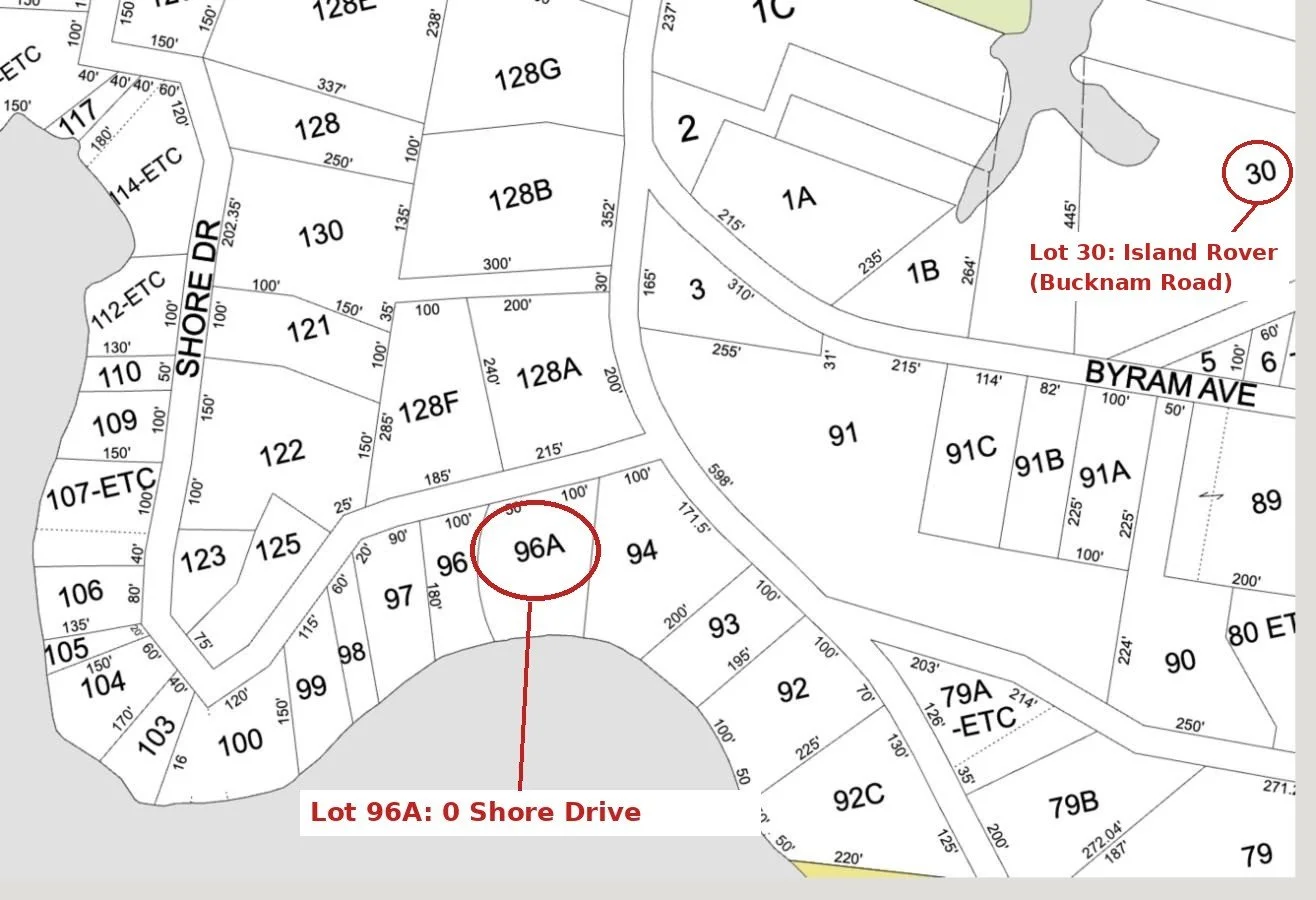
The launch site, Lot 96A on Tax Map 5, fronts the cove between Shore Drive and Lower Flying Point Road. The vessel sits on Lot 30, off Bucknam Road. Image source: Town of Freeport Property Map 5, 2021, annotated by Balsam Realty.
To make that legal, the petitioners did not write a permit for one lot. Instead, they created a new land use. A "temporary boat launching facility" would become a permitted use across the Medium Density Residential I district, which has two separate parts on the town zoning map: the tip of the Lower Flying Point peninsula and an inland neighborhood along Wardtown Road on the far side of Route One. Only the Lower Flying Point section touches the water. Counsel for the petitioners told the hearing that a narrower ordinance was not an option. "It has to be by law," she said.
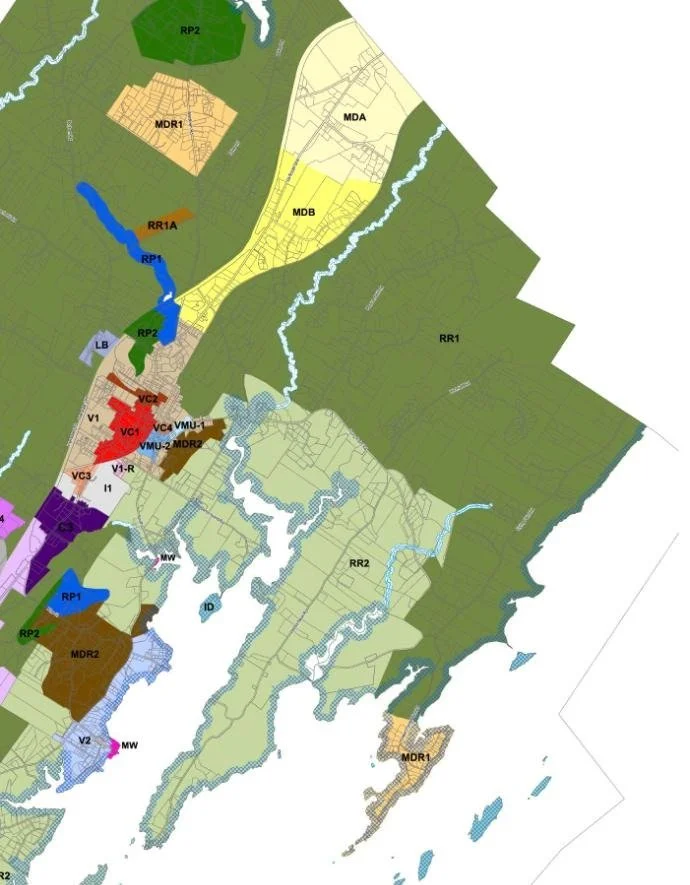
The two parts of the MDR-I district, inland on Wardtown Road (top) and at the tip of Lower Flying Point (bottom right). Image source: Town of Freeport Zoning Map, amended June 18, 2024.
For two years, any waterfront owner in the district could apply. In zoning terms, the change is from a project that goes before a board to a permitted use cleared by staff. Today a launch here goes before the Coastal Waters Commission and the Project Review Board, where abutters can be heard. Under the new ordinance, the request would be approved by the Codes Enforcement Officer if it meets the written standards. Those standards allow one launch per lot below the high water line and call for an access design prepared by a professional engineer. Vegetation cleared for the launch must be replanted after it is removed. The launch would also be exempt from the town's separate Temporary Activity Permit.
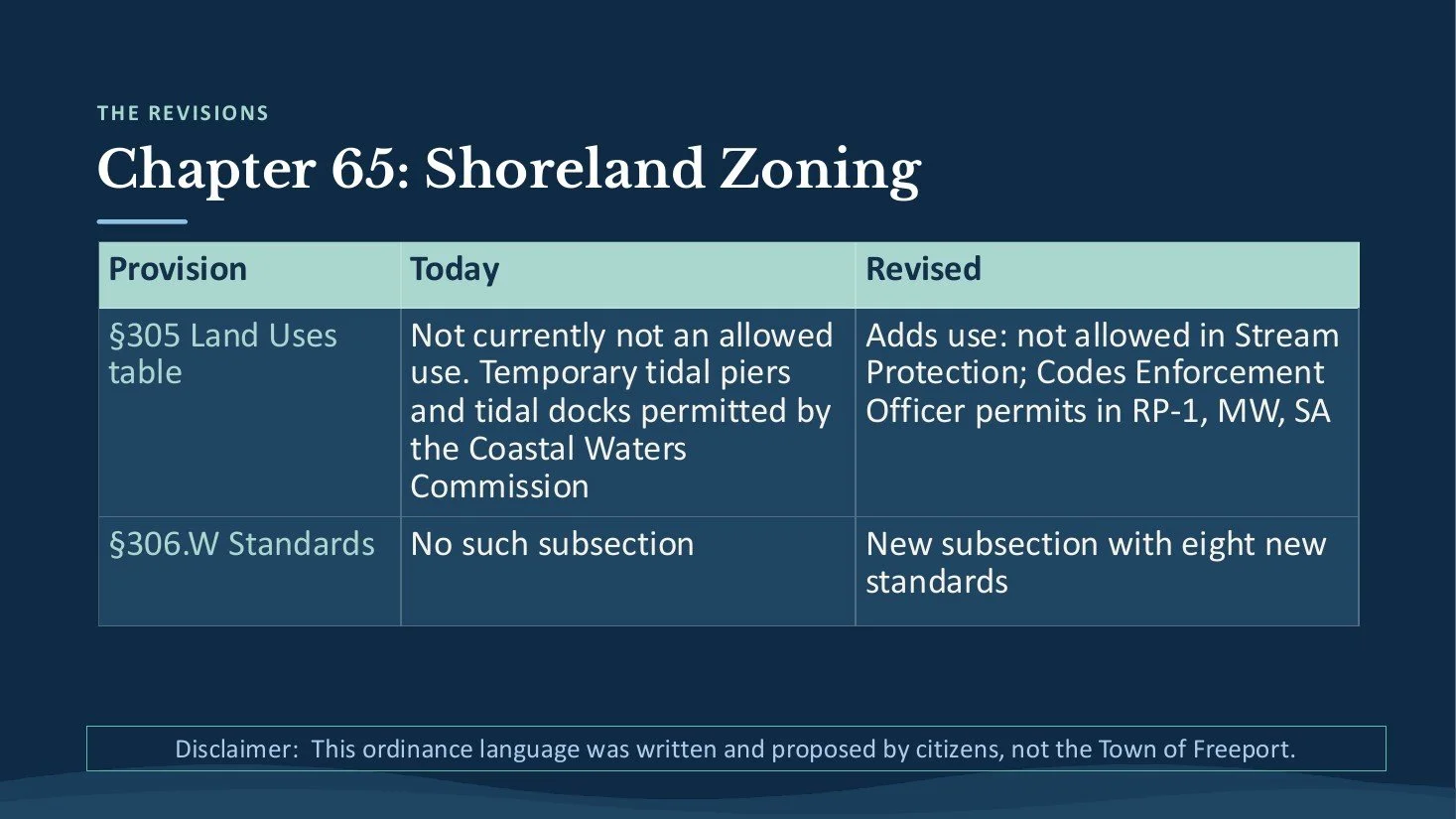
How the ordinance would amend the Shoreland Zoning Ordinance. Image source: Town of Freeport presentation, October 15, 2026 public hearing.
Two provisions widen who could qualify: a launch need not be accessory to a house or other permitted use, so it could sit on a lot with no home and a launch may also be built on a lot that does not meet minimum lot dimensional requirements, so small and substandard waterfront lots would be eligible. A facility could include a ramp across the shore, structures over the water and an access road through the coastal wetland. One built and used between October 15 and April 1 would be deemed to have no unreasonable impact on fish and wildlife habitat.
The 2023 application by Carter Becker for a boat launch at 0 Shore Drive shows what the current rules ask of a project like this. It described a ramp reaching about 110 feet past the highest annual tide line, roughly 11.5 percent of the way across the cove. It cited a Coastal Waters standard requiring at least 60 feet of shore frontage for a structure of that kind. The lot has about 100. The eight standards the ordinance adds for launches do not include a frontage minimum.
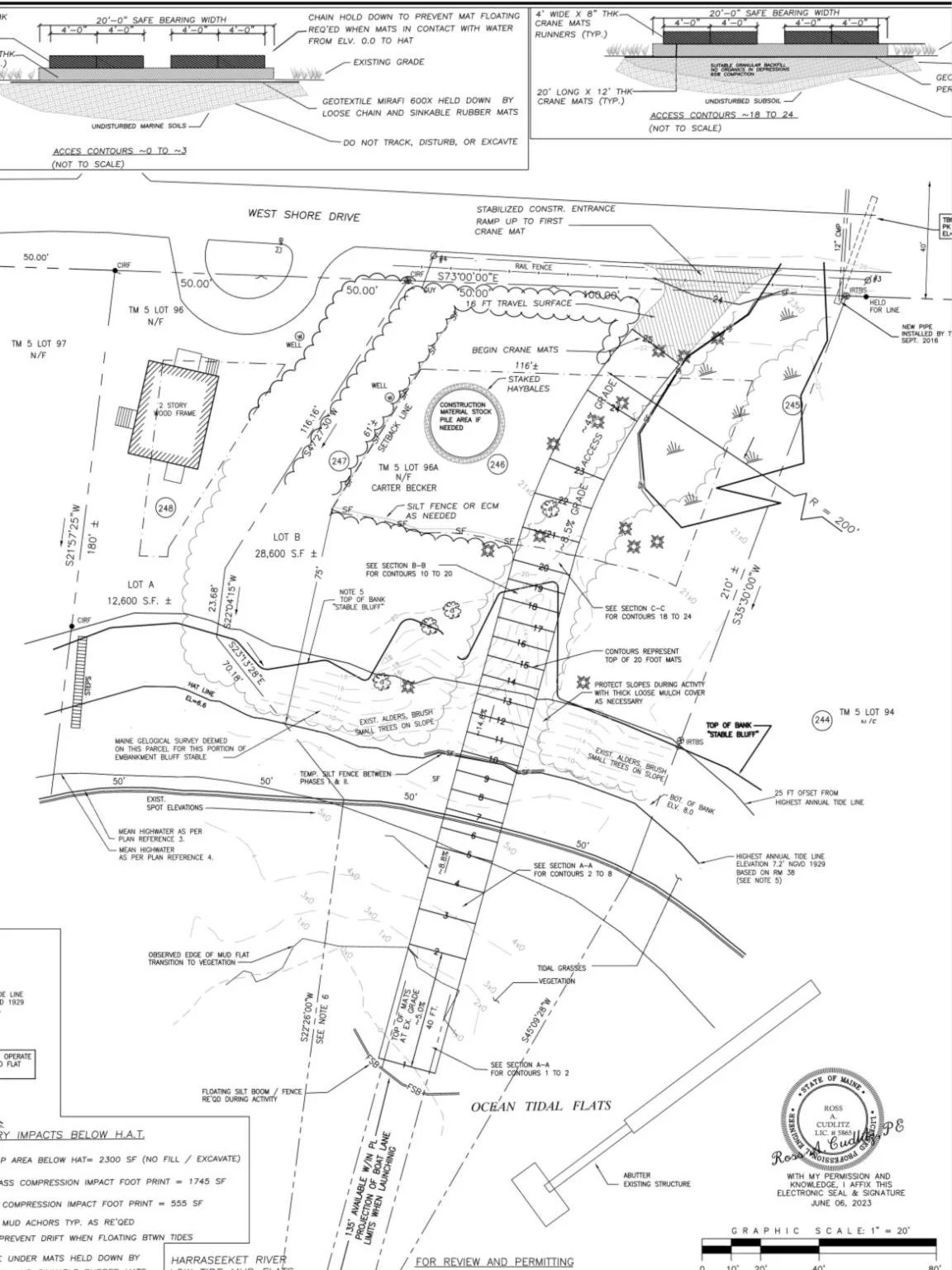
The proposed ramp of crane mats running from Shore Drive across the bank to the tidal flats. Abutters' names removed. Image source: Engineering Assistance & Design, site plan for Carter Becker dated June 6, 2023, in the application filed with the Freeport Coastal Waters Commission.
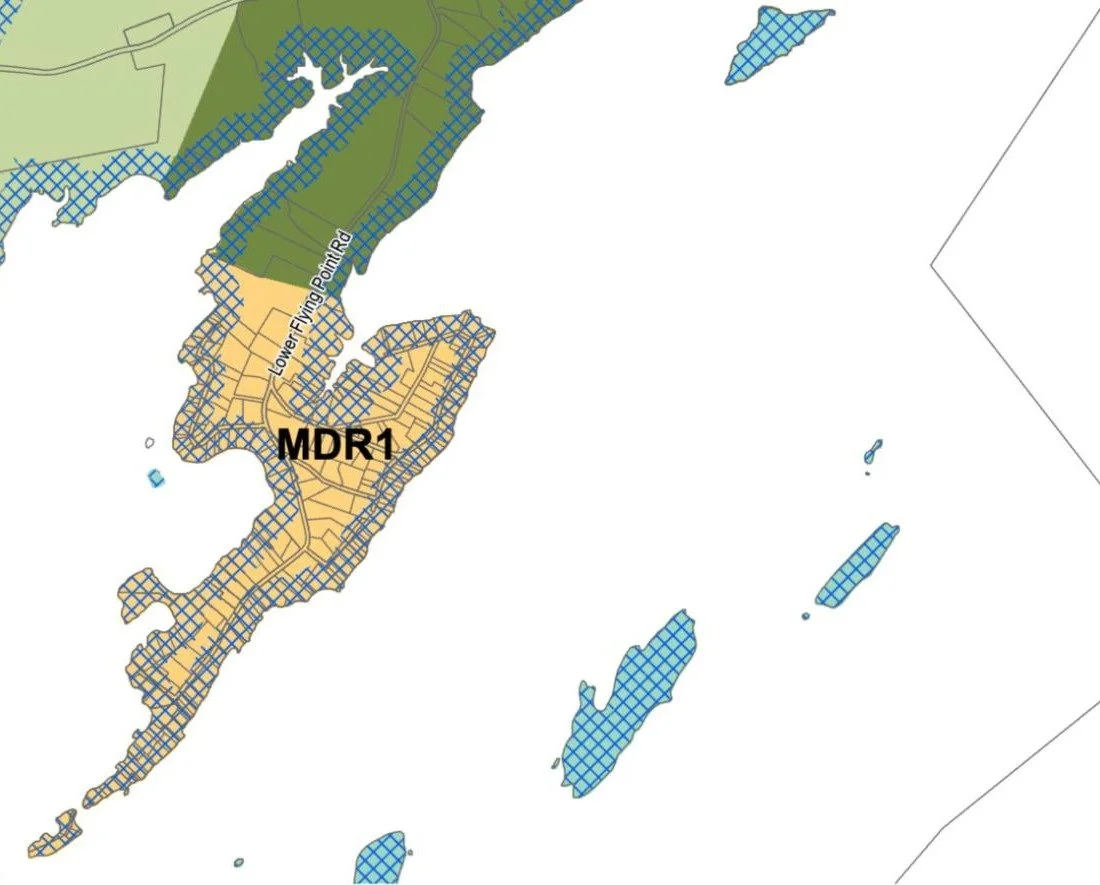
The Lower Flying Point section of MDR-I. The crosshatching marks the Shoreland Area. Image source: Town of Freeport Zoning Map, amended June 18, 2024.
In September 2025 the Coastal Waters Commission voted 5 to 0 to deny Mr. Becker's application for a launch at 0 Shore Drive, according to its minutes. On the wildlife habitat standard, which the ordinance would deem met for launches built and used between October 15 and April 1, the vote was 4 to 1. In a handout filed for the hearing the petitioners say the Commission found the impact unknown rather than harmful. Counsel for neighbors of the site told the hearing the Commission could not be convinced the launch would not cause harm.
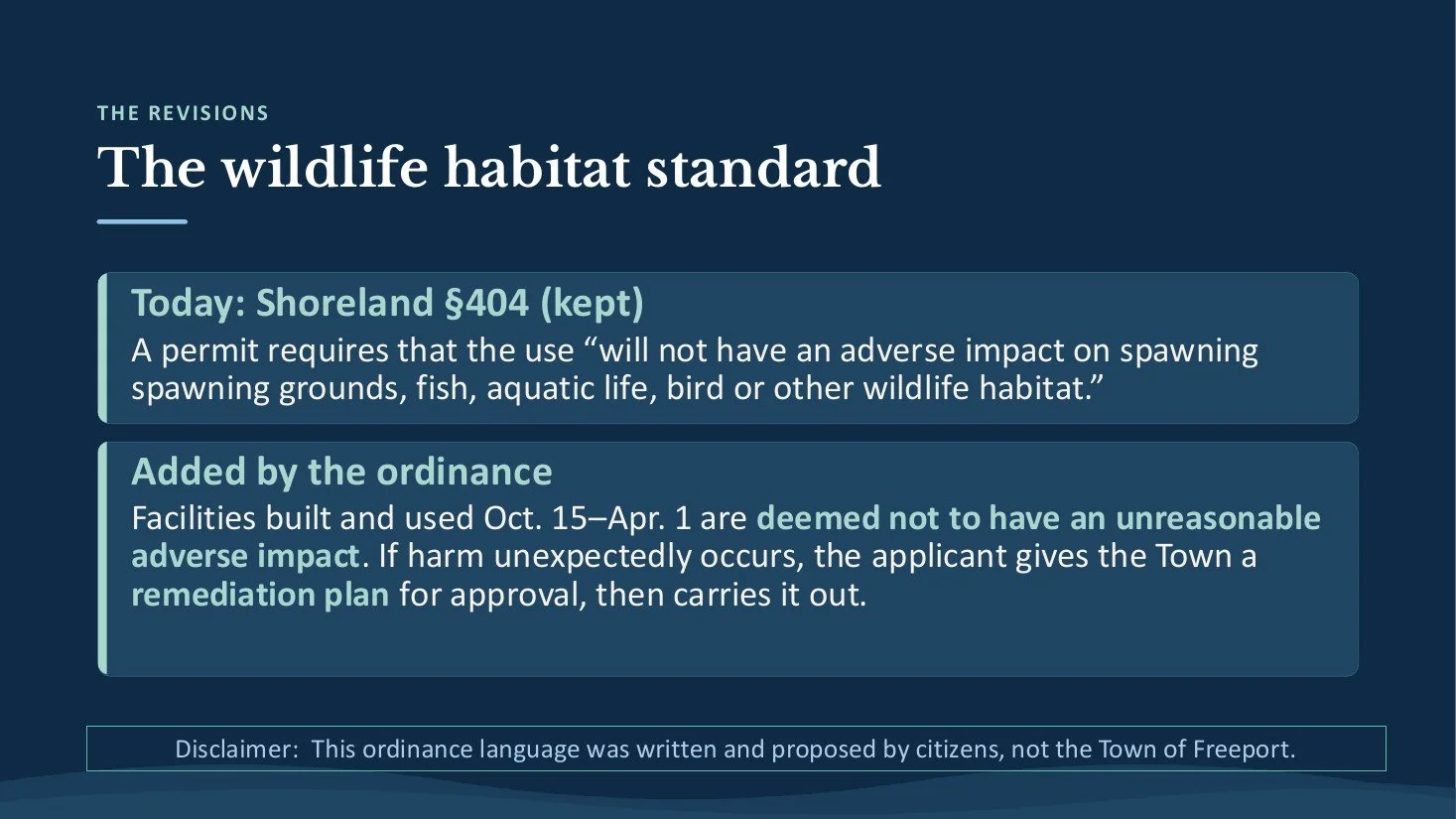
The wildlife habitat standard today and as the ordinance would change it. Image source: Town of Freeport presentation, October 15, 2026 public hearing.
The Two Year Question
This is where a property owner should slow down.
The ordinance expires after two years. Read quickly, that sounds like a short experiment. The word "temporary" invites the same reading. The ordinance defines the facility as "a temporary non-commercial facility designed primarily for the launching of watercraft." The only time limit it places on one is this: "A temporary boat launching facility may remain in or over the water for no more than seven (7) months in any period of twelve (12) consecutive months."
The Town Attorney reads "temporary" in that sense. It describes the season. It does not mean the launch ends when the ordinance does. A use that was lawful when it began generally survives a later rule change as a legally nonconforming use. A launch approved during the two years could go in each fall and come out each spring for as long as the owner keeps using it. "They're not temporary in the sense that after two years, the use evaporates," she told the hearing. The ballot question reflects her view.
The Town Manager told the Council an approved launch would not need a new permit each year and would stay with the property if it sold. That makes it part of what a buyer inherits and part of what goes into a seller's disclosure, much like a grandfathered dock.
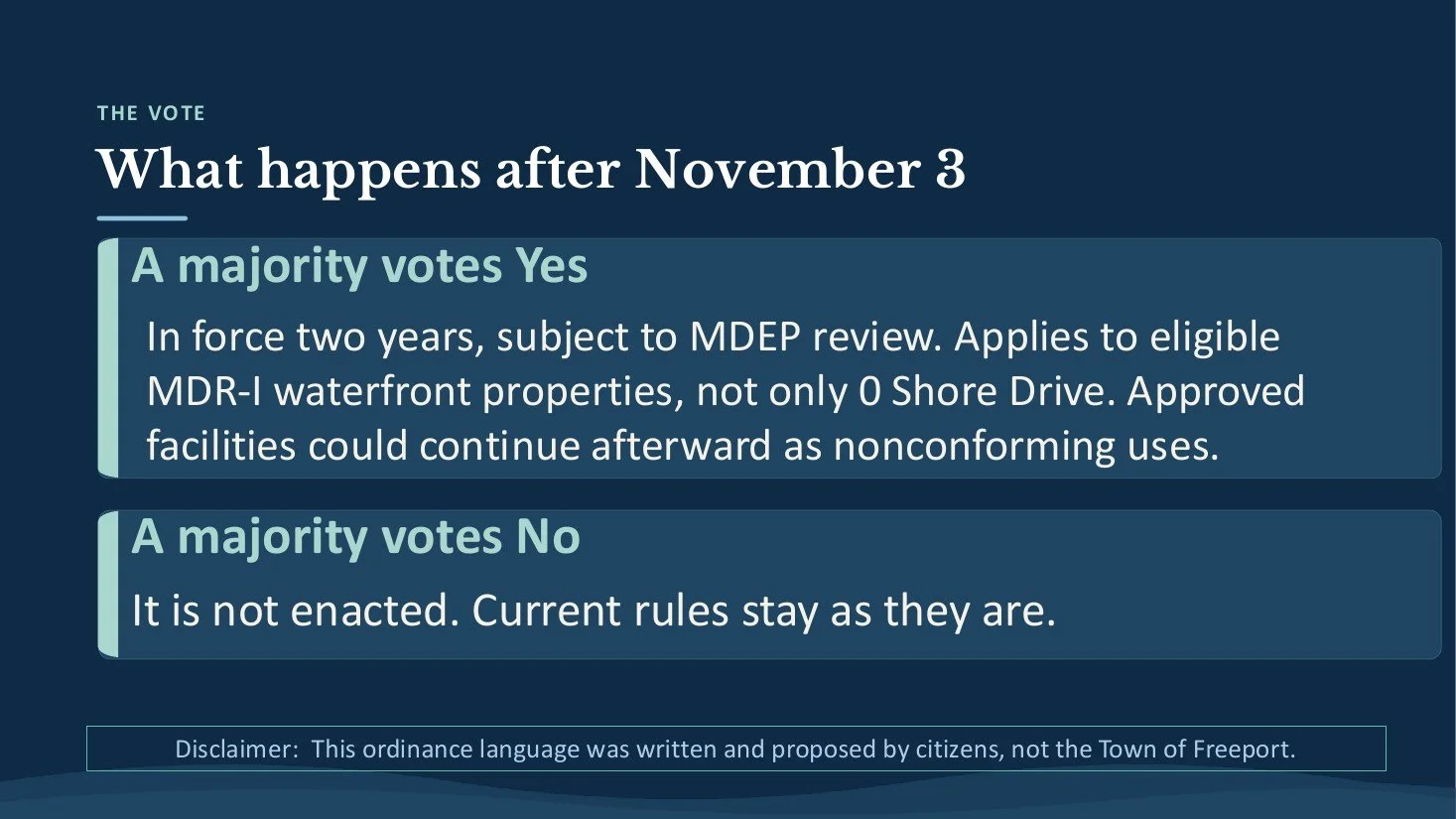
The Town's summary of a yes and a no vote. Image source: Town of Freeport presentation, October 15, 2026 public hearing.
Freeport's own code spells out what that inheritance looks like. Under Section 202 of the Shoreland Zoning Ordinance, a nonconforming use may pass to a new owner, who "may continue the non-conforming use." It may not be expanded. It is considered abandoned if the activity "ceases for a period of twelve (12) months," though the Project Review Board may grant up to a one year extension. The town's general Zoning Ordinance sets that clock at eighteen months. The ordinance does not say how either clock applies to a launch that must be out of the water at least five months of every year.
The zoning ordinance also has a way of keeping some short term uses from becoming permanent. Section 201.A provides that lemonade stands, farm stands and peddler trucks "shall not acquire the status of a lawful non-conforming use" if the rules later change. The launch ordinance contains no comparable clause.
The petitioners see it otherwise. Their Facts vs Fiction handout describes the sunset as removing the ordinance from the books. Their counsel said she believes a new permit would be needed each year, though she told the hearing she does not have a legal determination on that point. The petitioners also say that renting crane mats, dollies and lift bags every winter is expensive enough to keep anyone else from trying.
The Town Attorney has noted one more wrinkle. The shoreland amendments could be read to allow launches in Marine Waterfront and Resource Protection areas outside the district. She said she does not believe that was the intent.
Augusta Gets a Vote Too
A yes vote is not the last word. Any change to shoreland zoning goes to the Maine Department of Environmental Protection, which has 45 days to approve it, reject it or attach conditions. Town staff reported that DEP's informal comments on the first version indicate parts of the current text do not align with state shoreland zoning rules. The petitioners say they revised the ordinance in response to those comments. Because the ordinance is severable, a provision DEP strikes would fall while the rest stands. Depending on its size and scale, any actual launch may also need its own DEP and Army Corps of Engineers permits.
Meanwhile, in Court
The town began enforcement in 2004, when it called the shipbuilding a manufacturing use in a residential zone, the Portland Press Herald reported. It is now suing Mr. Arndt and Mr. Becker, who holds a security interest in the vessel, over who owns the ship and the land beneath it. The dispute traces to a 2014 agreement in which Mr. Arndt agreed to move the vessel within two years or cede ownership to the town. The Town Attorney told the hearing that a court-set deadline to move it passed without the vessel being moved. Trial begins December 7. Mr. Arndt has sued the town in turn. The petitioners say they would drop that suit if the boat is launched and would move it out of Freeport to the greater Casco Bay. Counsel for neighbors of the site told the hearing that ownership of the vessel would still be in litigation.
Mr. Arndt calls the hull a demonstration "of what can be built out of what other people have thrown away." In The Island Rover (Harold's Boat Problem), a documentary Jordan Meeder filmed from 2020 to 2023 that was featured on WCVB's Chronicle in October 2024, he describes a first voyage to the Arctic "with a class of 16 students." "That's just my dream," he says.
The Vote
Polls open November 3rd at the Freeport High School gymnasium. Absentee and early voting are available at Town Hall. The full ordinance, the ballot and the presentations from all sides are posted on the town's Citizens' Initiatives page. Owners on Lower Flying Point who want to know how the change could reach their own lot can check the town zoning map or call us.
Balsam Realty reports on property decisions in Freeport from the public record and takes no position on how to vote. We have no listing, client or other interest in 0 Shore Drive, the vessel or any party to the litigation.
This post is general information drawn from public documents and is not legal advice. Owners with questions about a specific lot should contact the Freeport Codes Enforcement Office or an attorney.
Sources:
Town of Freeport presentation, October 15, 2026 public hearing
Petitioners' presentation and Facts vs Fiction handout, October 15, 2026
Coastal Waters Commission application for 0 Shore Drive, revised October 17, 2023
Town of Freeport video of the September 1, 2026 Council meeting and the October 15, 2026 public hearing
Portland Press Herald, August 24, October 1 and October 7, 2026
The Island Rover (Harold's Boat Problem), directed by Jordan Meeder
Balsam Realty 207.865.0123 homework@balsamrealty.com BalsamRealty.com
